I Got It Wrong About Bomber Command

A few years ago I started writing family history into my poems. Perhaps it is because I don’t have children to pass the stories on to, I wanted to immortalise my parents and grandparents, now passed away, in my poetry.  Here’s my Dad, George Sutherland, born 1925, in his Air Training Corps uniform at about the mid-point of World War II.

He later trained as a radio operator and flew in Lancaster bombers, as part of the 617 “Dambusters” squadron, but after the dambuster pilots had left.  He loathed his boss, Group Captain Leonard Cheshire, whom he described as a ‘martinet’.  I wrote a sonnet about my Dad, who I think was a little wistful about missing the action.  To put in some colour, I mentioned a dance hall where my parents met, which they referred to as the “Mill Vane”, and also the command “scramble, boys”.  After the poem had been published, by the lovely boys at Prole Magazine, I found out that it was actually the “Milvain” and that Bomber Command never “scrambled” – that was the (reactive) job of the fighter pilots.  The bombers planned their missions pro-actively and were given orders earlier in the day in the “ops briefing”. (It was my mum who worked the capstan lathe at Vickers-Armstrong.) So I had to change my poem, a thing many poets never stop doing.

What Did You Do In The War?

Dancing at the Milvain on Saturday night
to “Don’t Sit Under the Apple Tree”,
the boys in uniform, the girls utility-bright
quickstepped the dangerous glamour of ’43.

In the Nissen hut, toasting cheese around the stove,
waiting for the ops briefing that wasn’t called;
at Vickers-Armstrong, working the capstan lathe
dodging the Doodlebug that didn’t fall.

By the time we were twenty it was over and out,
with only the briefest taste of enemy action;
into Civvy Street with a duffle bag of doubt
that anything would ever give more satisfaction.

Try telling the barefoot militants of ‘68
how we bought them all the peace they need to graduate.


Ledbury

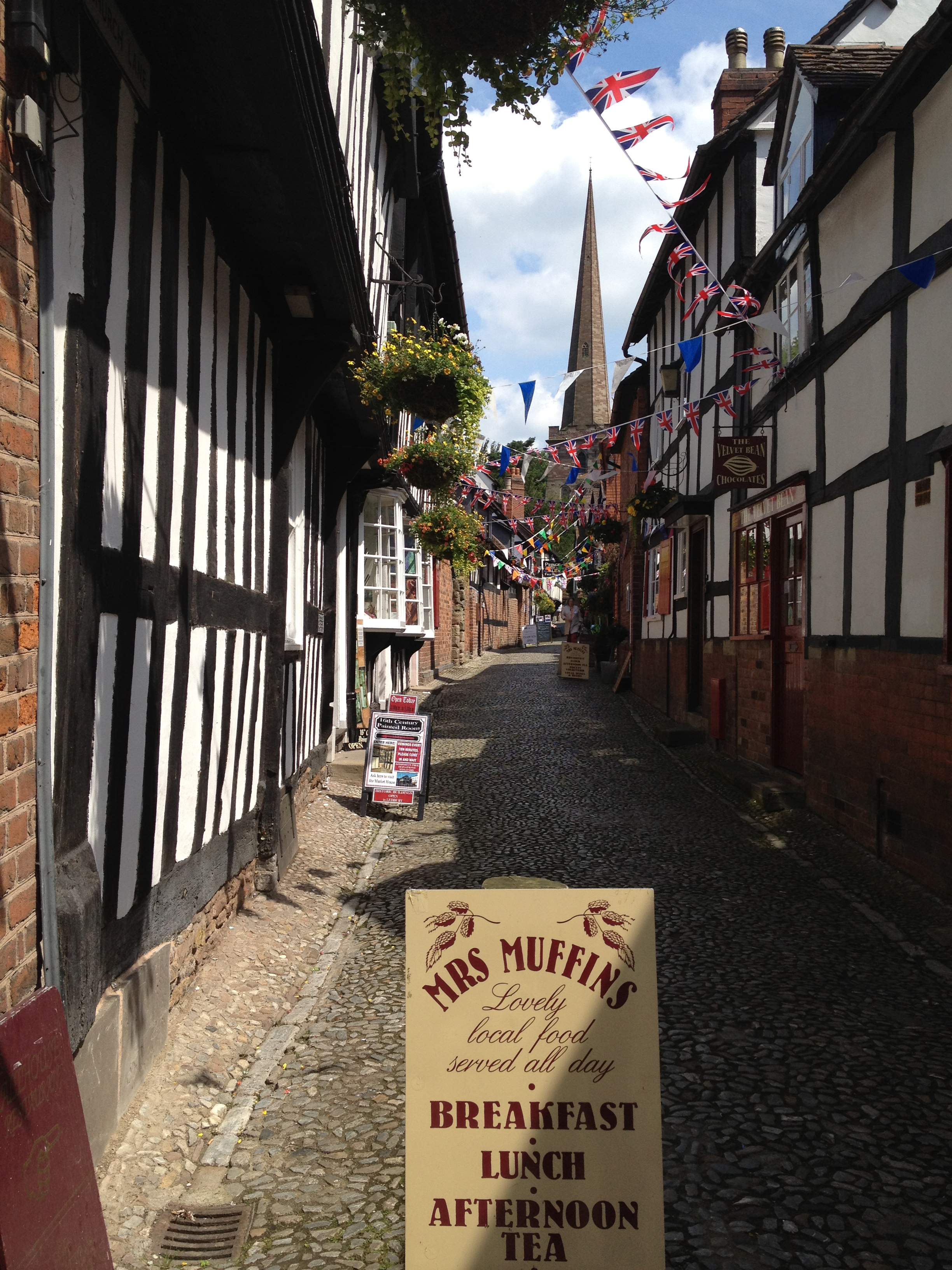
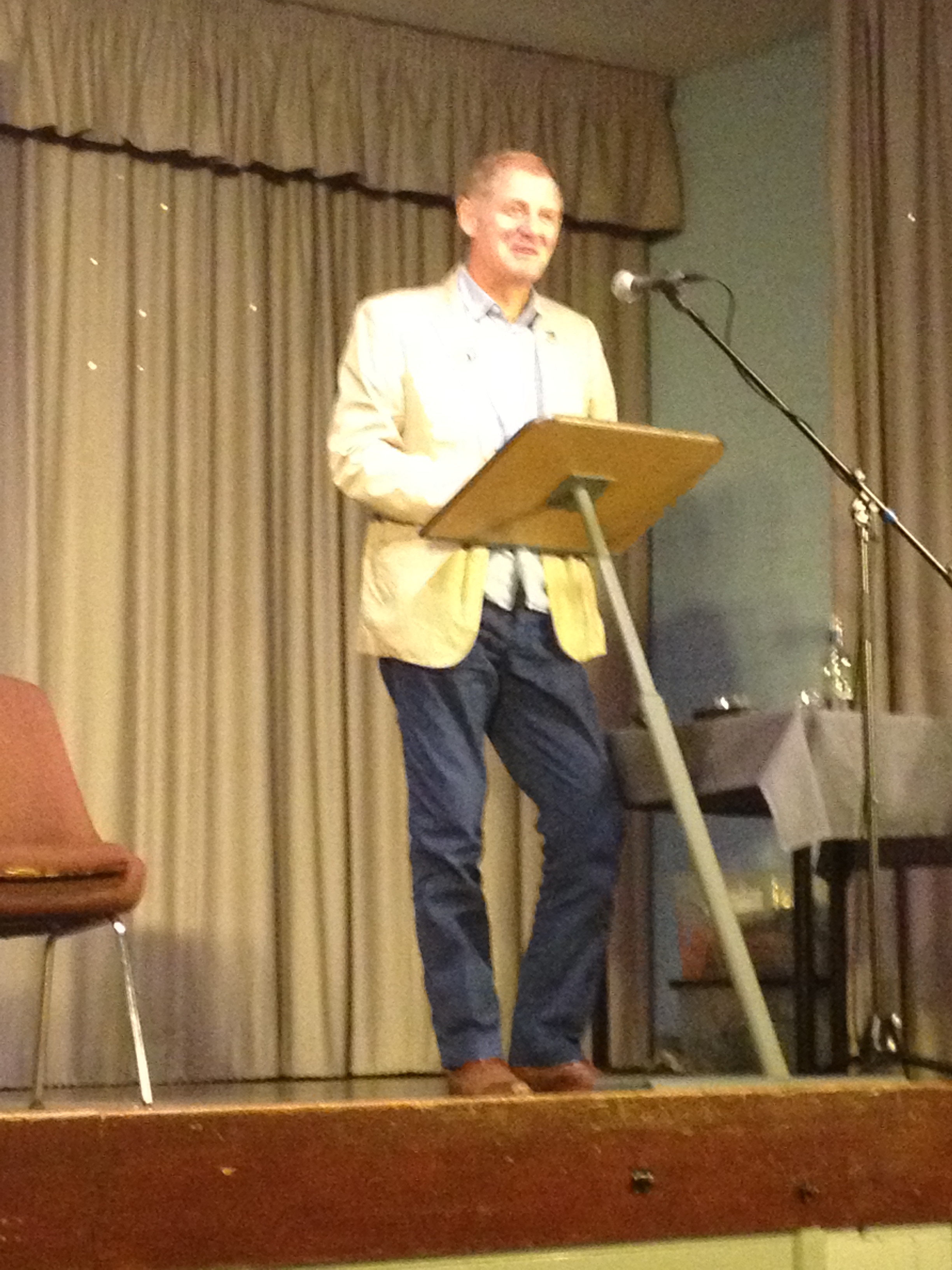
We caught the tail end of the Ledbury festival on Sunday.  For once, it wasn’t raining, and the little Herefordshire town looked stunning.  First event was Simon Armitage, talking about his new book Walking Home in which he describes walking the Pennine Way, contrarily from north to south.  He’s an engaging speaker and very funny too.  He read a few of his Stone Stanza poems which are about water, in all its forms, and how it shapes the landscape.  He has a great turn of phrase, for example, describing mist as ‘water in its ghost state’.  Brilliant.


Next was my Prof, Andrew Motion, speaking about his new novel Silver, a sequel to Treasure Island.  I’ve read it and enjoyed it, it’s very true to the Stevenson original in tone; a Ripping Yarn with deeper issues to consider.  Motion says he gets up at 5.30 every morning to write.  I’m full of admiration for people who do this in order to get at some of the things in their subconscious mind.  I struggle with that time of day.

Sophie Hannah was funny and quirky; Helen Dunmore was thoughtful and elegant.  Lastly we saw a group of poets reading together in a show called ‘What We Should Have Said’.  Hannah Silva works with sound, right at the edge of meaning.  Some of my friends don’t think this is poetry at all.  I’m still mulling it over.

Nosegaies and Wickerishe

I’m a member of the Poetry Society and receive their quarterly magazine, Poetry Review. This time they have had a guest editor, George Szirtes, one of the best contemporary poets, and a great Facebooker and Twitterer.  He has certainly chosen a fantastic selection of new poetry.  The one I absolutely love is AB Jackson’s “Of Elephants” which I don’t completely understand, but seems to be something to do with Pliny the Elder reporting on the habits of this exotic species, which Pliny himself may not have actually seen.  I love the way the poem is a mashup of real facts about elephants and complete fabrications. The whole effect of the archaic language, the elephants doing ” a kind of Morrish Dance” and the fact that they “snuffe and puffe” is magical.  The elephants seem wise, and friendly and even spiritual.

Normally I am wary of quoting huge chunks of poems that are in copyright, but I can see that this poem is available on the internet as a PDF, so… enjoy.

Of Elephants. AB Jackson


Boling For Broke

Last night, via i-player (a wonderful institution, especially because we can get it on our living-room TV) I caught up with the new BBC production of Richard II – the first of “The Hollow Crown” series of Shakespeare’s history plays. Maybe it was because it was a wonderful production, or maybe it is because my ear is now more attuned to verse, it made total sense to me – I knew who was who and what was going on, although I’ve never seen this play before and didn’t know the history.

Ben Wishaw was marvellously camp and Jesus-like as Richard. The scene where he reluctantly gives up the crown was a marvel.

And Rory Kinnear was terrific as Bolingbroke, the new Duke of Lancaster after the death of Jean-Luc Picard John of Gaunt.  Except that he seemed to have eyes that were different colours.  I checked Google Images and Rory Kinnear doesn’t appear to have different coloured eyes, so what was that about?

The scene where Bolingbroke’s forces approach the castle where Richard is holed up, and Richard is sitting on the ramparts in a pointy gold helmet, made me think, inevitably, of Monty Python and the Holy Grail.  If Richard had screamed “Fetchez la vache!” it would not have been out of character.  And the bit where Richard and his bishop wade out of the sea, alone, returning from the Irish wars, was somewhat unbelievable – they needed an armed retinue at the very least.

There aren’t so many really memorable quotations in this play, apart from the wonderful “this sceptred isle” speech delivered movingly by Patrick Stewart.  And the bit about the hollow crown itself:

“Within the hollow crown
That rounds the mortal temples of a king
Keeps Death his court, and there the antic sits,
Scoffing his state and mocking at  his pomp,
Allowing him a breath, a little scene,
To monarchize, be feared, and kill with looks”

‘And the best thing of all, the ring of it – sweet as a bell.’

I spent the whole of yesterday at Poetry Parnassus at the Southbank Centre in London.  I couldn’t be there every day this week without looking like a Simon Armitage stalker, but I treated myself to a day out.  Frank, my other half, gave me a lift as far as Osterley tube station on his way to work, so I got to the south bank about an hour before anything opened.  I was forced to take shelter in a cafe with latte and an organic almond croissant.

The first event was “an intimate reading” by Jo Shapcott of a number of her poems including her “bee poems” ( one of which you can find here at 14:55) which I’m getting more and more out of with re-reading.  I’ve been lucky enough this academic year to be one of Jo’s students at Royal Holloway, and the encouragement of attending her workshops has helped me a lot.  Her editor, Matthew Hollis, at Faber and Faber, described her to me as a “national treasure”, which indeed she is.

Next I attended a workshop with Kate Kilalea on how to tell secrets in poetry.  I struggle with making things up; many of my poems could be prefaced by the words “this is a true story”, which I put down to my training in science.  Somehow, nobody expects a novelist to tell a true story, but when a poet writes a poem, most people think it is strictly autobiographical.  It was fascinating to explore how much of us as poets is visible in our work, versus how much we choose to keep our distance.

During the breaks between events, I just hung out at the Clore Ballroom and watched the poets from 170 countries read their stuff, and there were some very eccentric readings indeed.  I think my favourite “random find” was Minoli Salgado, from Sri Lanka, who read poems that sounded absoutely beautiful, and also made me feel that the world is small – her preoccupations felt very familiar.  Also if I could “speak in tongues” I would choose Georgian.  Maya Sarashvili’s poems sounded like angels speaking; and it was almost a disappointment to find out, thanks to Sasha Dugdale’s beautifully crafted English version, that she was talking about missing her children as she went through airport security.

“Famous Seamus” Heaney is always a highlight, and I was delighted that he read his translation from the Irish of Rua Ó Súilleabháin, “Poet to Blacksmith” which is about how to make a spade, or a poem, in fact.  I love poems about making things.  I’ve written a few myself.

Wole Soyinka is another Nobel Prize winner. I couldn’t hear him so well, but he did read a funny long poem about going to the optician and being told that his eyes had such different prescriptions that they didn’t belong on the same person.  Much mirth ensued when a mobile phone rang in the middle of the performance and turned out to be Wole’s own.

Topping the bill was American former laureate, Kay Ryan, who was witty and thought-provoking and profound, and without any poetic ego.  I really must buy some of her work and see how she does it.

Eleven hours of poetry yesterday has taken its toll.  I was at home, gathering up the washing this morning, announcing:

“Now has come the hour of towels, for to every laundry there is a season”.


What’s Brewing?

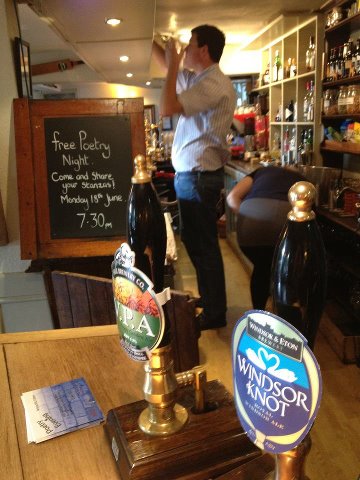
For complex reasons, I’m writing a series of beer poems.  I’m obsessed with craft and tradition, and some of my work to date reflects that.  So I embarked on my sequence by interviewing a 91 year old lady who used to go hop-picking on the Kent/Sussex border in the 1930s.  Last week I spent a couple of days watching a batch of beer being made at the fabulous Windsor and Eton Brewery – many thanks to Jim, Paddy and Will for letting me hang around and get in the way.

And just to prove how well beer and poetry go together, here’s the evidence.

Claire Trevien held a packed poetry night at the Jolly Cricketers, Seer Green, the other day.  Readers were Kayo Chingonyi, Emily Hasler, Kirsten Irving and James Byrne.  An impressive line-up of metropolitan poets who trundled to to the Sticks to entertain us. I really hope Claire hosts some more readings in the future.

Charting Corporate Life

There don’t seem to be a lot of poems about The Modern Workplace but I have had a go at the subject and I have heard one or two poems in the genre by younger poets.  I’ve written a few.  Here’s one slight piece which is based on a True Story.

Groupthink

The team is in the bar with a flipchart
drinking margaritas at five o’clock
devising a new Vision for our Brand.

It should be the best product on the market
the most recognised name in its sector
the best seller, with the major Share of Mind.

We contemplate the bullet points we’ve listed,
agree that they distil the very essence
of the factors critical for our success.

Then one of us takes up the magic marker
and scribbles on a fresh page of paper
“Team Vision” inscribing, in red, below:

EVERYBODY
SHOULD BE
MORE LIKE
US.


Kicking and Screaming

Yesterday I went on a one day WordPress course taught by Jamie Marsland at PootlePress.  As a complete newbie to website design, I achieved something cheap and legible in 24 hours; a place to blog about my writing and showcase some work.

Thank you Jamie! A highly recommended introduction for the Technically Challenged.  All I have to do now is gather some readers.

Prize!

I am delighted to have been awarded the Margaret Hewson Prize by literary agents Johnson & Alcock, who were kind enough to say a few nice things about me on their website.  Poets are used to having their poems rejected by magazines, so when somebody likes their work, it is a great boost to morale – and creativity!