From Sarsens to Clay

kidd

Image: copyright Roger Kidd, used under a Creative Commons licence.

A few weeks ago I went to a poetry workshop in Avebury, led by Jo Bell and Martin Malone. After a bracing walk around the stones, which we used as a starting point for our imagination, we began to consider our own personal archaeologies. As I come from Stoke on Trent, I took the derelict “pot banks” and their surrounding landscape as a theme, plus a line from a poem by Adam Thorpe, and wrote this:


Industrial Archaeology

It’s artificial and there’s nothing at the core
                              Adam Thorpe; ‘Silbury Hill’

It’s artificial and there’s nothing at the core
but clay and pebbles; this ditch and bank
cut for a waterway, that, for a motorway.
This sheer cliff a windowed warehouse
where plates nest on spacers made of fireclay
and pots hunker down in saggared cists.
Here a toilet-bowl midden cast out by Doulton
there, winding gear, as pithead megaliths.
Rounded cairns barrow within the landscape,
squat, strangely bottle-shaped and hollow
as a hermit’s cell. They bear traces of old fires,
their use no longer understood, but probably
of ritual significance. Today, all we remember is;
they’re artificial and there’s nothing at the core.

Sweet Smell of Success

Last night I went along to the Penning Perfumes event at the Albion Beatnik bookshop in Oxford, run by Claire Trevien and Odette Toilette.  This was a fascinating night, which showcased poems written in response to perfumes, and scents devised in response to poems.  In each case, the audience was treated to little paper sticks dipped in the scent, to accompany each poem, so we could enjoy the whole experience.

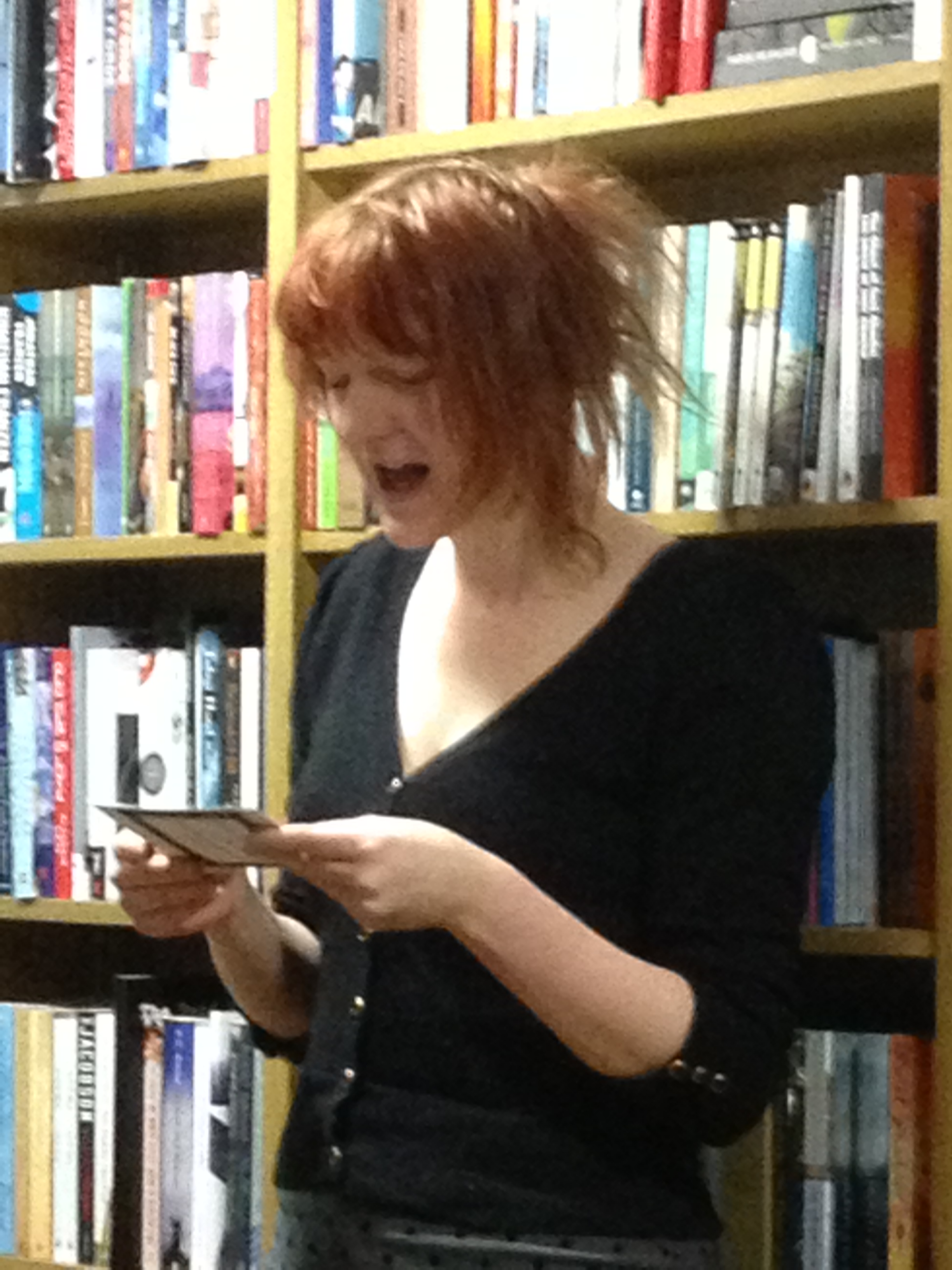
Here’s Claire, who read one of her own poems, about the Paris Opera on a rainy night, which resulted in a wonderful scent redolent of wet leather coats.

Penning Perfumes 002And here, with Ms Odette Toilette herself, are three other poets, Dan Holloway, Eloise Stonborough, and Lucy Ayrton, who produced quite different responses to the same scent, reminding us that those Proustian moments are so subjective.

Penning Perfumes 005

Another speaker was John Stephen of the Cotswold Perfumery, who had us sniffing some very unusual scents.  Our response to them changed depending on what we had been told about them beforehand.  He made the excellent point that chefs and perfumers depend on being able to describe their work in terms of words, and how difficult it can be.  After all, the sense of scent is a primitive part of the limbic system, while our language capacity is relatively recently evolved.

I wonder what strange melange of whiffs, niffs, pongs and stinks greeted Dennis when he opened up the Albion Beatnik bookshop this morning?  We had experienced a number of conventional perfumes, plus the scents of rosemary, bonfires, stinky cheese, lapsang souchong, Vick’s vapour rub and Izal toilet paper. By the end of the evening, people were making slips of the tongue like “I don’t normally wear poetry” and “I wrote this perfume”. I’m inspired to try some olfactory ekphrasis myself.

A Poem for First Great Western

Paddington 001


Connecting Services

For a population suffering ABC1 socioeconomic
demographics, Henley on Thames
is under-deserved by First Great Western,
its hourly service simply not executive
for a serious commute to London Paddington.
While the parking is suspiciously adequate
and seats always outwardly available,
it is the return which leaves something on the line
to be desired; the wrong kind of No,
and comes to a complete next station stop.
We signal failure of trains and are disconnected
to fifty five cold minutes platformed at Twyford;
sometimes I think my life has no real purpose.
Surely your timetable will be sensible
to Regatta this line a far higher frequency
allowing value customers to homeward importantly,
derailed and minimally shunted.

The Clockhouse Mystery

photo (10)A Collection of Poets, various and strange; staff who flit, almost silently, from room to room; mysterious, Svengali-like tutors who exert a magical influence on their hapless charges.  Several inches of snow. No way in, no way out. No footprints.

We wondered if, one morning, one of us would fail to appear around the large communal breakfast table, perhaps found stabbed through the heart by an icicle, the murder weapon having vanished in the toasty heat of the victim’s room. The perfect Murder Mystery…

While we waited for the screams, we wrote. We wrote our last wills and testaments, we wrote kisses, lectures, sex tips for the dead*. We turned our loved ones into furniture. And at the end of the week, we spoke, we gave evidence, we bore witness. Gathered in the library, the denoument was delivered. Each of us was somehow involved, said Miss Bird, exercising the little grey cells. Each of us was responsible, each of us compelled, somehow, to write.

This has been an Arvon Production at The Hurst. Please don’t have nightmares.

* ‘The earth has to move first’ – said Bob.

Solstice

A few years ago, a poetry class I was in was challenged to write a seasonal poem.  This was my attempt, inspired by a news item about a Dark Skies Park in Galloway.  It was published in Acumen No. 68, in September 2010.

Solstice

In these northern latitudes, the light is sparse
and winter bares its white and weathered fist
against the fastnesses of night.

We decorate the darkness, cannot stand
its plain finality.  Daub it with tinsel
dress it in baubles, switch on season’s greetings
in the streets.  Perhaps God is dead;
perhaps the shortest day
will dwindle into black.

The brilliant gift-wrapped sacrifice
is not far away now.  Pause a while.
Let your eyes become accustomed
to  these dark skies; perhaps they hold the light
of a billion stars.


The Next (but one) Big Thing

There has been this meme going round lately – I’m told it is called a “blog-hop” in which writers answer ten questions about the book they are working on, and then tag their writer friends to do the same the following week.  Susanna Jones, one of our Creative Writing lecturers at Royal Holloway, has several published books already, and was kind enough to tag me for this week, so here goes:

1.       What is the working title of your next first book?

I was planning to call it ‘The Gift of Artemis’, which sounds a bit pompous, but ‘Artemis’ Gift’ has a tricky possessive apostrophe, and if I switched the goddess’ name to ‘Diana’, all the Daily Express readers would get over-excited. So, the short answer is, I’m not quite sure. What do you think?

2. Where did the idea come from for the book?

People say ‘write what you know’ and I spent twenty years in the pharmaceutical and biotechnology industries, so that seemed like a good place to start.  Also, I was incensed by John Le Carré’s portrayal of pharma companies as nasty, unethical exploiters of African patients in The Constant Gardener, so I wondered if I could redress the balance a little.

3. What genre does your book fall under?

Literary fiction? Cerebral thriller? Medical Mystery Tour?

4. What actors would you choose to play the characters in a movie rendition?

Well, the female protagonist, Sarah, is a researcher in Chemistry at Oxford University.  In my mind’s eye she looks like a woman I was an undergraduate with many years ago.  She has a few Bridget Jonesey qualities, so Renee Zellweger might be an obvious choice, or maybe Rosamund Pike or Jessica Hynes. Helping her is Ben, a rather flippant and cynical young man who works for a biotech start-up company. That’s a job for someone like James McEvoy or Matthew Macfadyen, perhaps.

5. What is the one-sentence synopsis of your book?

Scientists uncover the story of a plant with healing properties, and go in search of it. But they find they are not the only people interested…

6. Is your book represented by an agency?

My agent is Anna Power at Johnson & Alcock.  She signed me up on the basis of my poetry, but I’ve shown Anna a draft of the first chapter and she said she would like to read some more.  So I had better write some more… (I’m writing this to shame myself into getting re-started)

7. How long did it take you to write the first draft of your manuscript?

You are asking that in the wrong tense.  I’m still working on the first draft.  I’ve had 15,000 words written since 2005. Corporate life and poetry have been in the way ever since. There’s nothing but Facebook, Twitter and housework stopping me now.

8. What other books would you compare this to within your genre?

I’m re-reading A.S.Byatt’s Possession at the moment, for inspiration.  I love the way she weaves in such a huge amount of detail, some fact, some fiction, to make a tale of literary research so intriguing. I also aspire to write like Robertson Davies’ Cornish Trilogy.

9. Who or what inspired you to write this book?

Mr Le Carré, as mentioned above.  Plus, I was snoozing in bed one morning and heard a report on the Today programme about the Pringle Archive, which is a real and mysterious collection of medical correspondence collected by an 18th Century Scottish physician. For many years this archive was kept unopened due to a provision in Pringle’s will, but a court case in 2004 overturned this wish, and the bequest was opened up to researchers. I wrote to the Royal College of Physicians of Scotland in Edinburgh, and they let me go and take a look at it. That’s where the trail starts.

10. What else about this book might pique the reader’s interest?

I’m putting in all sorts of detail about ancient medicine and magic, biblical arcana, botanically-based drugs, and the history of science in general from Paracelsus to the Patent Office.

I’ve tagged several writers to tell you about their Next big Thing next Wednesday:

Alexandra Clare is a novelist and short story writer who writes on her long commute by train. Her work is at www.twentysixwordstories.blogspot.co.uk

Sarah McEvoy is a writer of science fiction and fantasy.  Her facebook page is here.

Kate Noakes is an accomplished poet with three published collections and another one almost ready.  She is working on her first novel and you will find the details here.

Susie Campbell writes poetry and prose, and had just embarked on the MSt course in Oxford. Her blog is here.

Laura Johnson is a friend of Sarah McEvoy’s and asked to be tagged.  I’m looking forward to hearing about her book!


A week is a long time in poetry

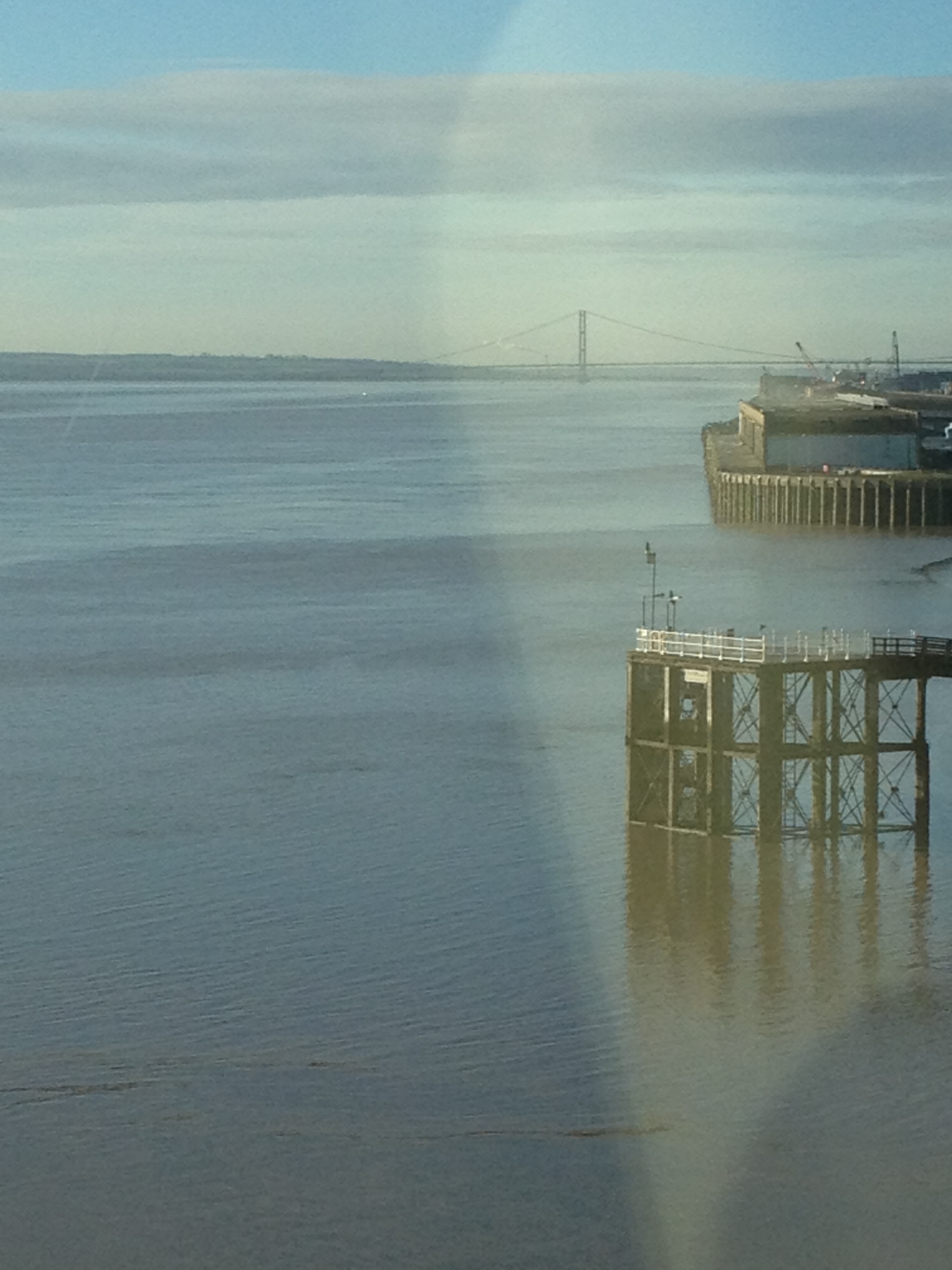
This time last week I braved the floods to go to Hull for the Lightship Literary awards, where I was a runner up with one of my London poems, which is now in the Lightship’s gorgeous anthology.

I met some lovely fellow-writers, including some who had travelled from America and Australia to attend the awards, and had a chance to take a good look around Hull – a city I had never been to before – well, it’s not really on the way to anywhere else. The refurbished marina was quite splendid, and I loved The Deep – a beautiful building housing a spectacular aquarium. And here, in Larkin’s words, is the place ‘where Lincolnshire, and sky and water meet’.

Then on Monday night, it was a great pleasure to go along to the venerable Troubadour coffee house in West Brompton, to read one of my poems as a finalist in their annual poetry awards, curated by Anne-Marie Fyfe, and judged by Jane Draycott and Bernard O’Donoghue, who read 3,300 competition entries in five weeks.  It was good to meet Vanessa Gebbie, the over all winner, who is a friend of a friend on facebook, and Judy Brown, whose poetry collection, Loudness, I recently bought from Seren. Our smiling faces, and our poems, are all shown here.

Last night, a few of us from the new Poetry Society Reading Stanza group went along to a Christmas reading at Reading University. Jeff Hilson and Tim Atkins explained their own personal poetics and each read from three collections.  They are definitely on the more experimental end of the poetry spectrum. Atkins said he rejects lyricism, and also tries to steer clear of metaphor and simile.  I was glad of the explanations behind the poems, which helped me make sense of them.  I wonder how well I would have got on without those explanations! But certainly I’m going to look up more of their work.

American Poetry

Jorie Graham, who was in the UK recently to pick up her Forward Prize for a collection called P L A C E , took the opportunity while she was here to make some comments about American versus British poetry.

PN Review reports her interview with Guardian writer Nicholas Wroe.  Allegedly, Graham:

compared the health of British Poetry favourably with that of the United States, likening it to “a kind of canary down the mine. Very few cultures in the history of humanity have survived if their poetry disappears.  The fact that it is astonishingly healthy in the UK should reassure people who, just as in the US, are worried about the culture. But with a poetry culture as vivid and alive as it is in the UK, your canary seems to be doing OK in your mine. Our canary is running out of breath and croaking a little.”

A few days after I read that, I had a conversation with a poet friend who happens to be part of a workshop group populated by both British and American poets.  She and I agreed on a lot of things.  American poetry seems close to prose-chopped-into-short-lines.  My friend says it looks like someone has ‘vomited on the page’.  She bewails the lack of craft the American writers display.  ‘They feel that once they’ve got everything that was in their head down on to the page, they’ve finished.’ There’s also a hugely confessional aspect to American poetry, in which raw and unprocessed emotions splurge out. We don’t really like it much.  By contrast, British poetry seems more crafted, more thoughtful, more worked and finished, slightly more oblique.

The whole schism began around the time of Walt Whitman. British poets based their work on their public school classical educations, imitating Shakespeare and Milton, while, in America, Whitman celebrated the huge American outdoors with long, expansive lines based on psalms and preaching styles.  I can see a line traced from Whitman to Ginsberg, to the “I have a dream” speech of Martin Luther King, to poets like Jorie Graham. Eliot crossed the pond, bringing a free verse style that transfused British poetry to some extent, but we still hark back to metre and sonics in a way that the Americans seem to have left behind.

At least, that’s the way it seems to me now. Next term in Roddy Lumsden’s “Here, There and Now” classes at the Poetry School, we are going to be studying contemporary American poets. Either I will learn to appreciate the wheezing of their gasping canary, or I’ll try to throttle it.

An Idea Whose Time has Gone

This poem owes a lot, style-wise, to Sean O’Brien’s ‘Timor Mortis’, and a lot, content-wise to a group of Facebook friends from whom I crowdsourced the ideas.  But I wrote it to support a cause I strongly believe in. The Sun began Page 3 in 1970. Women stripped to the knickers in a ‘family newspaper’ sends poor messages to both men and women.  If you want to understand the sexual intimidation and bullying women still have to put up with, take a look at the Everyday Sexism Project. Then ask yourself whether Page 3 is likely to make the situation A) better or B) worse.

Big in the 70s

Sometimes it’s good to bring to mind
all the naff stuff we left behind;
Fanny Cradock, nylon sheets,
avocado bathroom suites,
Bernard Manning, Love Thy Neighbour,
crinkly Izal toilet paper,
Stylophones and Irish jokes,
‘I mean that most sincerely, folks’,
public payphones, party lines,
crimplene and Rise ‘n’ Shine,
Bob Monkhouse and the Golden Shot,
the decade that all taste forgot,
Checkpoint Charlie, dolly-birds,
Brut and ‘Are You Being Served?’
blacking up for Minstrel shows
how that was normal, no-one knows.
George and Mildred, Benny Hill,
seaside postcards, sleeping pills,
OMO, Gary Glitter, flares,
Kevin Keegan’s curly hair,
incense sticks – patchouli-scented,
all dead, all gone, all unlamented.
Flowery wallpaper, New Faces,
cigarettes in public places,
Stars on Sunday, Uri Geller,
Cinderella Rockefella,
Austin Allegro, Ford Cortina,
Confessions of a Window-Cleaner.
Showaddywaddy, Paper Lace,
all disappeared without a trace,
Dennis Wheatley, Robin Day,
no legal right to equal pay,
Playtex girdles, Dr White’s,
Vesta curries, orange tights,
Inflation, twenty-five percent,
Mrs Thatcher’s government,
the Vietnam War and Watergate,
golliwogs with marmalade.
Tommy Cannon, Bobby Ball,
we didn’t need them after all.
Ali Bongo, Whitbread beer,
the Yorkshire Ripper, Slimcea,
Jimmy Savile, Legs & Co.,
scarletina, polio,
apartheid, birching, Chopper bikes,
the three-day week and all-out strikes;
ideas whose times have come and gone
and almost all of us moved on.
But while there’s knockers on page three
the Sun’s stuck in the Seventies.

So, support the petition, please. No More Page 3.


photo from Tim Ireland’s excellent blog: 
http://www.bloggerheads.com/page-3/